

The Log Files dialog allows you to define the log file folder to be used by NLS, and to see what log files are present in the log folder.
Note: you can only use the log files dialog when you are running NLSM on the same computer as the license server, as it requires direct access to the file system of the server computer.
Using the Log Files dialog
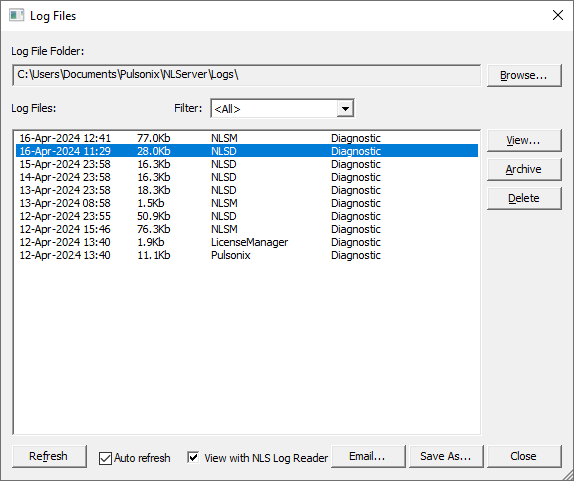
Log File Folder
At the top of the dialog you can see the current setting for the folder to be used for storing NLS log files. You can change this to a different folder by clicking Browse and navigating to the required folder.
Any logging information written by NLS from that point onwards will be written to files in the newly selected folder.
Log Files
All log files found in the currently selected log folder will be listed here, with the most recently modified file at the top of the list.
There is also a ‘Filter’ you can use to selectively view only the log files relating to a particular application.
Viewing log files
To view the contents of a log file, select that file in the list, and click View. By default, log files will be opened in the dedicated NLS log reader (NLSL) program.
If you prefer, you can uncheck the View with NLS Log Reader box and the files will be opened by whatever application on your system is configured to read “.log” files.
Most of the information normally recorded in the log file relates to applications starting and stopping, and booking out and returning licenses. If you have been advised to use any additional diagnostic settings to help with trouble-shooting problems, you may see other entries in the log file.
Archiving log files
You may wish to tidy up your log folder from time to time. You can either do this yourself using Windows Explorer, or you can use the Archive button to move all the selected files into an “Archive” sub-folder. They will then disappear from the list of log files.
Deleting log files
If instead you simply want to tidy up by deleting files, the Delete button will remove all the selected files from the log folder.
Sending information to support channel
When you have one or more log files selected in the list, the Email button becomes available. When you click this button, you will be prompted to provide a name for the Zip file which will be created. This Zip file will include the selected log files, the License.ini file that contains licensing settings, and if NLSM is running on the server it will also include your NLS configuration file (.NLC) if you have one defined.
Once the Zip file is created, it should be opened in your current default email application, ready to send to the relevant support location.